A NOTE ON THIS INFORMATION
Permitting rules, zoning designations, and local tax rates for short-term rentals change and vary by jurisdiction, and can differ based on your property’s specific history and location. This article is for general informational purposes only, is not legal advice, and is not a substitute for verifying current requirements yourself. Always confirm permitting, zoning, and tax obligations directly with Sevier County, the City of Gatlinburg, or the City of Pigeon Forge before making decisions about your property. Smoky Woods Retreats does not file permits, handle zoning matters, or submit tax paperwork on behalf of owners.
If you own a cabin in the Smokies and rent it short-term, permitting is not a background detail you can put off. Sevier County, Gatlinburg, and Pigeon Forge each run their own rules, and getting the wrong one wrong can mean losing your right to rent at all — not just a fine.
Unincorporated Sevier County: The Annual STRU Permit
If your cabin sits outside city limits — which covers a large share of the Cosby, Wears Valley, and outlying Gatlinburg-area cabins we manage — you’re required to hold a Short-Term Rental Unit (STRU) permit, in place since January 1, 2024. The permit runs $250 a year for units sleeping 12 or fewer guests, with $25 added per additional occupant for larger properties (The Short Term Shop).
The permit isn’t just paperwork. It requires an annual life-safety inspection covering smoke alarms, carbon monoxide detectors, marked escape routes, and electrical systems, renewed each year in the month it was originally issued. Properties that submitted their initial application on time were allowed to keep renting while waiting on their first inspection — but wait times of six to ten months from the fire marshal aren’t unusual, and a lapsed permit isn’t something you can quietly let ride (Avada Properties).
Grandfathering Doesn’t Follow the Property the Way Owners Assume
This is the part that catches new owners off guard most often. If a cabin had “grandfathered” status under older building codes, that protection does not automatically transfer when the property changes hands. It can also be lost if the cabin sits unused as a rental for 30 months or more, or if the property racks up three or more violations. Buy a cabin assuming its existing rental history protects you, and you may find yourself needing a full code-compliance upgrade you never budgeted for.
We see this most with owners who bought a cabin specifically because it was “already an Airbnb” — and didn’t confirm what that status actually was worth once the deed changed hands.
Gatlinburg City Limits: A Different Set of Rules Entirely
Inside Gatlinburg’s city limits, the STRU permit doesn’t apply — you’re dealing with a Tourist Residency Permit instead, plus three separate registrations: a city business license, a county business license, and a Tennessee Department of Revenue tax ID. Zoning matters here too. Short-term rentals are permitted in R-1 zones with an approved permit and site plan, but the ordinance does not explicitly allow them in R-1A, R-2, R-2A, or R-3 zoning — a distinction that trips up buyers who assume “it’s in Gatlinburg” settles the question.
Pigeon Forge: Size Triggers a Different Code Entirely
Pigeon Forge has its own threshold most owners don’t see coming. Cross more than five sleeping rooms, 12 or more occupants, 5,000 square feet of total space (decks included), or three stories, and your cabin gets treated as a hotel/motel occupancy under the building code — meaning sprinkler systems, exit requirements, and guardrail standards well beyond a standard residential build. Plans for anything in this category need a Tennessee-registered architect or engineer’s seal before submission (The Short Term Shop).
Taxes Layer on Top, and They’re Not Uniform
Every jurisdiction here taxes differently, and it’s easy to under-collect if you’re self-managing across multiple listings. Unincorporated Sevier County charges a 3% lodging tax, due monthly by the 20th, applied to rent plus cleaning fees, pet fees, and other guest charges. Gatlinburg layers a 1.25% gross receipts tax with a 3% hotel/motel tax. Pigeon Forge runs a 2.5% hotel/motel privilege tax plus a 1% gross receipts tax on transient lodging. None of these are optional, and getting the collection and remittance wrong is its own separate problem from the permitting question.
What Actually Happens If You Skip It
Missing a permit deadline in unincorporated Sevier County doesn’t just mean a fine, though fines are part of it. It means losing the grandfathered exemption to older building codes, which can force retroactive upgrades to meet 2016 Tennessee Building Code standards — wiring, egress, fire separation, the kind of work that’s disruptive and expensive to do on an occupied rental. In the more serious cases, it means a rental prohibition until the property is brought into compliance, which is a very different conversation with your booking calendar than a late fee.
None of this is designed to be punitive for its own sake. Sevier County, Gatlinburg, and Pigeon Forge have all watched short-term rental density climb fast over the past several years, and the permitting systems exist largely because life-safety inspections weren’t happening consistently before. That context doesn’t make the paperwork optional, but it does explain why enforcement has gotten more consistent rather than less.
WHERE THIS ACTUALLY GOES WRONG
Almost every permitting problem we see traces back to one of three things: an owner who assumed a prior owner’s grandfathered status carried over, an owner who didn’t realize their zoning designation blocked short-term rental use outright, or an owner managing a cabin remotely who missed a renewal window. None of these show up until an inspection, a complaint, or a sale falls through.
If You’re Not Sure Where Your Cabin Stands
Permitting status, zoning, and grandfathering history are exactly the kind of thing that’s easy to assume and expensive to get wrong — especially if you bought a cabin that was “already renting” and never independently verified what permit it was actually operating under. If you manage your cabin yourself and want a second set of eyes on your listing and its underlying setup, our $9.99 Airbnb Listing Audit is the easiest first step — it won’t file your paperwork, but it will tell you plainly whether your listing and operation look like they’re built to last or built to catch you off guard.
Get My Listing Audit →
And if you’d rather have a local team handle the day-to-day of running your cabin as a rental — bookings, guest communication, turnovers, and pricing — that’s what our full-service management is built for. Permitting, zoning, and tax compliance remain the owner’s responsibility in every case; we recommend verifying current requirements directly with the relevant county or city office.
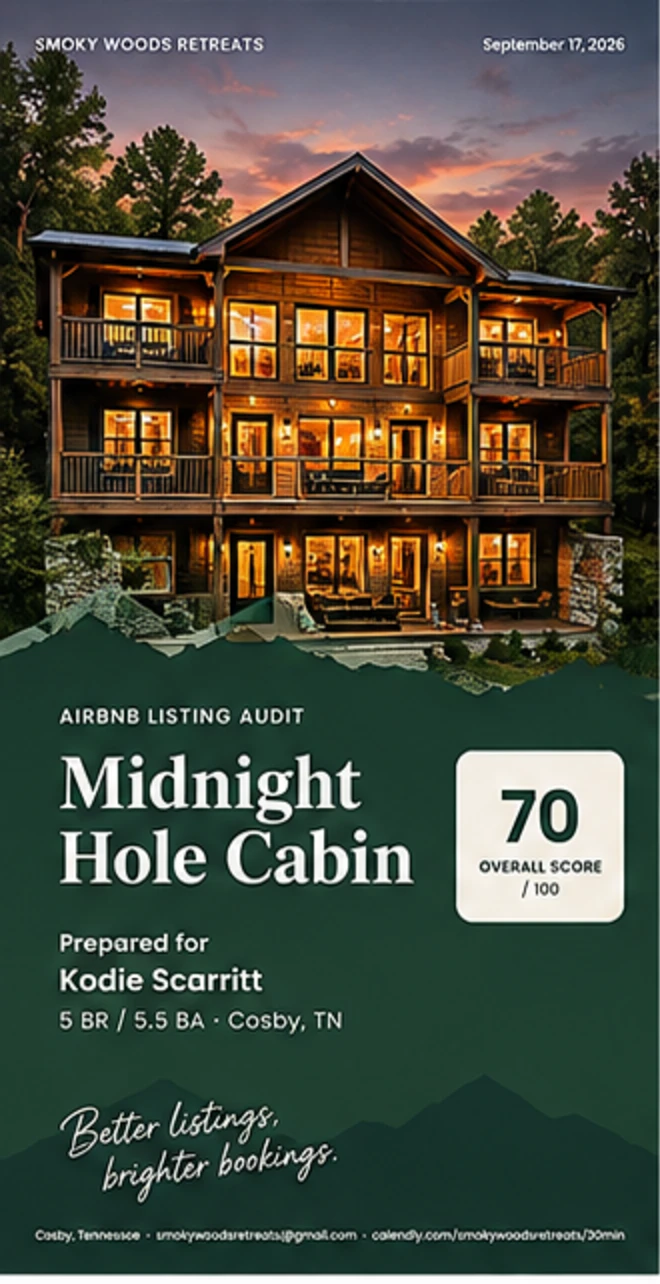 Sample audit — 8 pages, in your inbox within 24 hours