We get some version of this question almost every week from owners in Gatlinburg, Pigeon Forge, and Sevierville: “My cabin is nice, my photos are decent, so why is it buried on page four?” The honest answer is almost never the cabin itself. It’s that Airbnb and Vrbo are not ranking the property — they’re ranking the host’s behavior, and most owners have no idea they’re being scored on it every single day.
With thousands of cabins competing for the same guest searches across Gatlinburg, Pigeon Forge, Sevierville, and Cosby, a small drop in where you land in search isn’t a cosmetic issue. It’s the difference between a fully booked October and a calendar full of gaps you end up discounting to fill. So let’s walk through what we actually know about how these two platforms decide who shows up first — not the forum speculation, but what Airbnb and Vrbo themselves have published.
The Algorithm Isn’t Ranking Your Cabin — It’s Ranking You
Airbnb is fairly direct about this. Its own search ranking guidance for hosts lists price, availability, length of stay, hospitality, popularity, listing quality, photography, amenities, and responsiveness as factors that “Airbnb uses an algorithm to generate search results that appeal to guests,” weighing each one differently depending on the search. Notice how few of those are about the cabin itself. Most of them are about how you run it.
That distinction matters because it means two nearly identical A-frames a mile apart on the same road can perform completely differently in search, purely based on how responsive, reliable, and consistent each host has been over the trailing months. We’ve watched this play out inside our own portfolio more times than we can count.
The Operational Metrics Doing the Heavy Lifting
Response Rate and Response Time
Airbnb tracks the percentage of guest inquiries you answer, and how fast. This isn’t a vanity number buried in your dashboard — it’s one of the four pillars of Superhost status, which Airbnb confirms requires hosts to “maintain a response rate of 90% or higher” within 24 hours. A guest messaging at 11pm about a Gatlinburg weekend isn’t going to wait until morning for three other hosts to answer first. If you’re not the one who replies, the algorithm notices who they booked with instead.
Acceptance Rate
Every time you decline or let a reservation request time out, that’s logged. A pattern of declines signals to the platform that your calendar or your preferences don’t match what guests expect when they find your listing, which is exactly the kind of mismatch a ranking algorithm exists to correct for.
Cancellations
This is the one owners underestimate the most. Airbnb requires Superhosts to keep cancellations under 1%, and Vrbo has gone even further — its newly expanded Premier Host program, detailed in Expedia’s own newsroom announcement, now requires individual listings to hit a 0% cancellation rate, a 99% acceptance rate, and a 9.2+ review score to carry the badge. A single owner-initiated cancellation during peak leaf season can undo months of ranking progress on a property.
Review Recency and Volume
Airbnb’s help documentation is clear that “higher quality listings with better ratings and reviews tend to rank higher in search,” but the detail most owners miss is that it’s not just your lifetime average. A cabin with a strong rating from two years ago and nothing recent reads very differently to the algorithm than one with a steady, current stream of five-star stays.
Booking Conversion and “Wish List” Activity
Airbnb explicitly factors in “how often guests save a listing to their wishlist” and how often a search impression turns into an actual booking. In other words, it’s tracking the gap between how many people see your cabin and how many of them act on it — and a listing that gets looked at but not booked is treated as a weaker match, not a lucky miss.
Pricing Competitiveness
Airbnb states plainly that listings “priced below other comparable listings in the area with similar characteristics…tend to rank higher in search.” Competitive doesn’t mean cheapest, and it doesn’t mean static — it means priced correctly relative to what’s actually booking around you this week, which in a seasonal market like ours shifts constantly.
Superhost and Premier Host Status
These badges aren’t just trust signals for guests scrolling search results — they’re built directly from the metrics above, which means losing the badge and losing ranking tend to happen together, not separately.
Listing Completeness
Photography, amenity tags, and a complete description all factor into what Airbnb calls an “effective listing page.” We’ve written before about the specific photo mistakes that quietly cost Smoky Mountain hosts bookings, and about the gaps most listings don’t realize they’re missing — both of which feed directly into this part of the algorithm, separate from the operational metrics above.
Vrbo Is Tightening, Not Loosening, the Bar
If you’ve assumed Vrbo is the more forgiving platform, that’s changing fast. Beyond the stricter Premier Host thresholds mentioned above, Vrbo also introduced a “Loved by Guests” badge for properties scoring 9.4 or higher across cleanliness, location, listing accuracy, and check-in ease — and both badges now function as filters guests can apply directly in search. That means underperforming on these metrics doesn’t just hurt your position in the default sort; it can remove you from a filtered search entirely.
WHAT WE SEE IN THE DATA
Across our own portfolio, we routinely see two cabins with nearly identical specs, nightly rates, and photo quality land in completely different search positions. The gap almost always traces back to a combination of response time, cancellation history, and how recently reviews have come in — not to anything a guest would notice by looking at the listing itself.
Why This Matters More Here Than in Most Markets
Gatlinburg, Pigeon Forge, and Sevierville have one of the densest concentrations of short-term rentals in the country, and Cosby isn’t far behind as inventory keeps expanding. Guests searching these areas aren’t choosing between five cabins — they’re choosing between hundreds, often on the same dates, often with similar views and similar amenities. In a market this saturated, ranking a few positions lower doesn’t cost you a handful of bookings. It can mean the difference between a listing that fills itself and one that only books when you drop the price to compete.
The frustrating part is that most owners can’t actually see where they’re losing ground. Airbnb and Vrbo don’t hand you a scorecard showing which of these factors is dragging your specific listing down — you only see the symptom, which is a calendar with more gaps than it should have.
Find Out Where Your Listing Is Actually Losing Ground
This is exactly what we built the Airbnb Listing Audit to answer. For $9.99, we go through your specific listing against the ranking factors above and tell you, in plain terms, where you’re strong and where you’re quietly losing search position — so you’re not guessing which lever to pull.
GET YOUR LISTING AUDITED →
And if what you’re really dealing with is the day-to-day reality of keeping response times low and cancellations at zero across a busy season — while also managing turnovers, guest messages, and pricing — that’s the operational side we handle for the properties in our management program. It’s a big part of why the cabins we manage tend to hold their search position even during the slower stretches of the year.
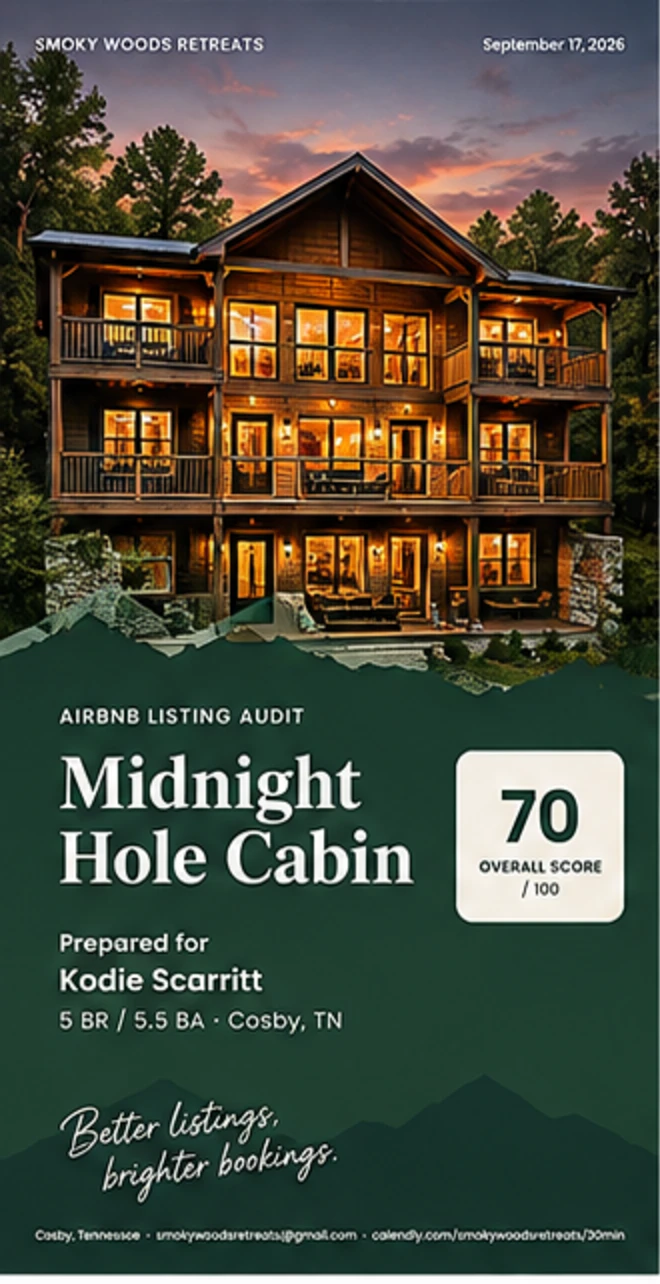 Sample audit — 8 pages, in your inbox within 24 hours