Great Smoky Mountains National Park is still the most visited national park in the country, and it isn’t close. In 2024, 12.2 million people came through the park, a 20% increase over the last decade, and their spending in gateway towns like Gatlinburg and Pigeon Forge supported an estimated $2.2 billion in local economic activity (NPS visitation data). So if your cabin’s calendar has more empty nights than it used to, we can tell you this much for free: it isn’t because people stopped coming to the Smokies.
The Market Usually Isn’t the Problem
We manage cabins across Gatlinburg, Pigeon Forge, Sevierville, and Cosby, and we hear some version of the same concern from owners on a regular basis: bookings feel slower than they should, or a cabin that used to fill itself is suddenly sitting open on weekends it never used to. Almost every time we dig in, the demand is still there. What’s usually going on is something specific to the listing, the pricing, or the operations behind it, quiet issues that don’t show up until you know where to look.
Most of the owners we talk to fall into one of two groups: people self-managing a single cabin while juggling a full-time job elsewhere, or owners with two or three properties who assumed the workload would stay manageable as they grew. Both groups tend to run into the same handful of blind spots, usually because there’s no time left in the week to step back and audit the listing the way a guest actually sees it. Here are five of the most common ones we see, and what each one usually means.
1. Your Pricing Isn’t Moving With the Season
The Smokies don’t have one busy season, they have several overlapping ones, and pricing that doesn’t account for that leaves money on the table in some months and empty nights in others. Rates generally need to shift on at least three different rhythms: the big seasonal swings (summer highs, a fall peak, a winter holiday surge, and a steadier spring), local event and weekend spikes tied to things like Dollywood’s seasonal calendar or fall foliage weekends, and the booking window itself, since holiday travelers often plan months ahead while couples’ getaways get booked at the last minute (seasonality data via The Short Term Shop). A cabin priced the same way in March as it is in October is almost always mispriced for one of the two.
2. Your Photos Haven’t Kept Up With What Guests Expect
Guest taste in this market has shifted noticeably over the last few years. The cabins getting the most attention right now tend to be brighter and more design-forward, moving away from the heavy timber and bear-motif decor that used to define a “Smoky Mountain cabin” (recent coverage of top-performing Smokies rentals). If your listing photos are more than a couple of years old, or your description still reads like every other cabin listing in the area, you’re likely losing the split-second decision guests make when they’re scrolling through search results.
3. Your Cleanliness Reviews Are Slipping, or No One’s Watching Them
Turnover quality is one of the fastest ways a listing’s star rating erodes, and it’s also one of the easiest things for a busy owner to lose track of. A single “not as clean as expected” review can sit at the top of your listing for months. If you’re not regularly checking in on turnover consistency, or if you don’t have someone independently verifying it after every guest, it’s worth a hard look at what’s actually happening between checkouts and check-ins.
4. Guest Communication Isn’t Fast or Consistent
Response time affects both your booking rate and your reviews, and it’s one of the hardest things to keep consistent without a system built for it. A guest who messages at 11pm with a question about the hot tub and doesn’t hear back until morning is a guest who’s more likely to leave a lukewarm review, even if the stay itself went fine. If communication depends on you personally being available around the clock, gaps are inevitable.
5. You’re Only Listed on One Platform
Airbnb and VRBO each reach a different slice of travelers, and relying on just one caps how many people ever see your cabin in the first place. It also means an algorithm change on that one platform can hit your bookings harder than it should. Owners who manage channel distribution deliberately, rather than defaulting to whichever platform they signed up for first, tend to have more stable calendars year-round.
How to Know Which One Is Actually Hurting You
Most owners recognize at least one of these five in their own listing, but guessing which one is actually costing bookings, and what to do about it, is a different problem. Our $9.99 Airbnb Listing Audit takes a real look at your title, photos, description, pricing structure, and amenities, and sends back a written breakdown of what’s likely working against you.
Get Your Listing Audit →
When It’s More Than a Fix
Sometimes the answer is a handful of changes an owner can make in an afternoon. Other times, what an owner really needs isn’t a fix, it’s someone dialing in pricing every week, keeping communication fast around the clock, and holding turnover cleaning to a standard that doesn’t slip when things get busy. That’s the gap our full-service property management covers for owners across the Smokies, for a flat 15% of revenue, with no long list of hidden fees stacked on top.
Either way, the first step is the same: find out what’s actually going on with your listing before you guess at a fix. It’s tempting to chase the newest advice you read in a Facebook group or assume last month’s slow week was just bad luck, but STR performance in this market is rarely random. There’s almost always a reason a cabin under-performs, and it’s usually one of a handful of things, not a mystery.
We’ve been managing cabins in Gatlinburg, Pigeon Forge, Sevierville, and Cosby long enough to know the difference between a normal seasonal dip and a listing that needs real attention. If you’re not sure which one you’re looking at, that’s exactly what we’re here for.
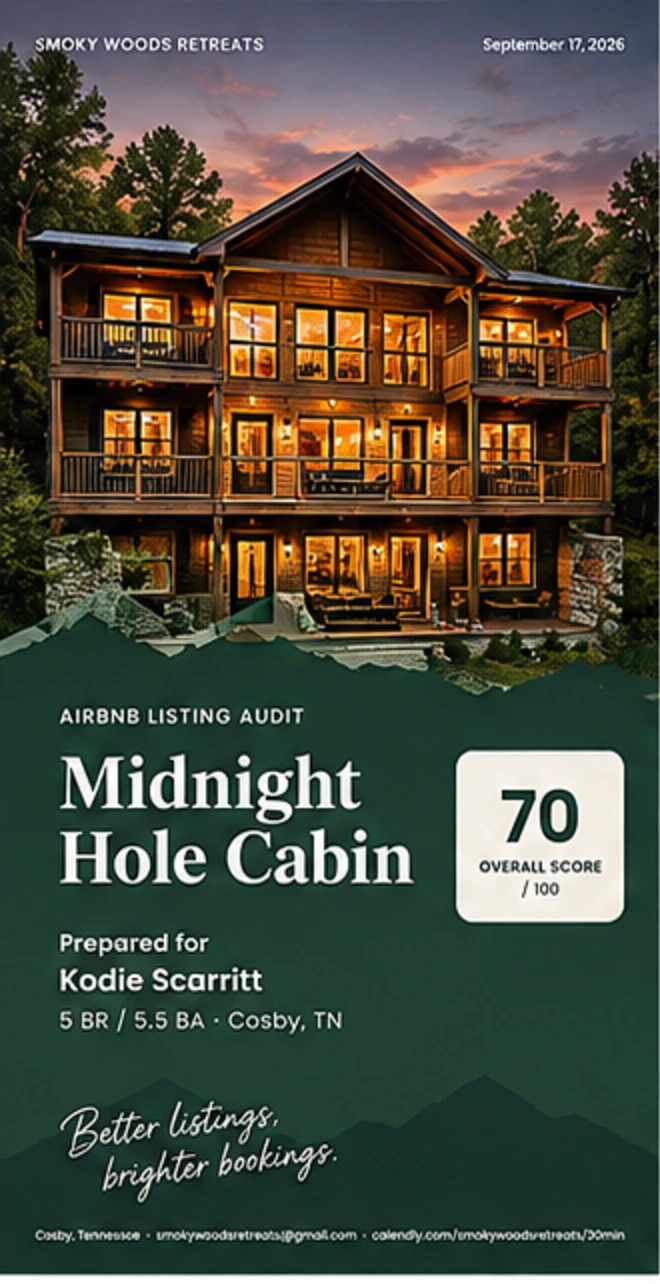 Sample audit — 8 pages, in your inbox within 24 hours