We look at a lot of Smoky Mountain cabin listings — our own and other owners’ — and the same handful of fixable issues show up over and over. Rather than critique one specific listing, here’s the actual walkthrough we run, in order, so you can apply it to your own.
Step One: The Title, Read Cold
A strong title focuses on one or two real differentiators rather than generic praise, stays around 50–60 characters so it doesn’t get cut off, and uses concrete descriptors — bedroom count, a standout amenity, proximity to something guests are searching for — instead of adjectives like “cozy” or “amazing” that every other listing also uses (PriceLabs). Emojis, ALL CAPS, and excessive punctuation tend to read as noise rather than emphasis. If your title could describe half the cabins in Gatlinburg, that’s the first thing worth rewriting.
Step Two: The Cover Photo, for Half a Second
We genuinely try to judge it the way a guest scrolling through search results would — a fast, almost unconscious read. Does it show the cabin’s actual best feature, well-lit, from an angle that reads clearly at thumbnail size? A strong gallery runs 15–30 high-quality images total: wide shots of every key space, close-ups of standout amenities, and enough exterior and setting context that a guest understands what they’re booking before they’ve read a word (PriceLabs).
Step Three: The Description, Scanned Like a Guest Would
Most guests are reading on a phone, scanning rather than reading closely. A description in the 150–250 word range, organized into clear sections — the space, guest access, neighborhood, things to note — performs better than one long paragraph (PriceLabs). We also check for honesty about limitations: stairs, limited parking, a shared driveway. Guests forgive a disclosed limitation. They don’t forgive an undisclosed one they discover at check-in.
Step Four: The Cross-Check
This is the step that catches the most surprising issues. Do the amenities listed actually match what’s shown in the photos and described in the text? A hot tub in the photos that isn’t checked off in amenities. A pet policy mentioned in the description that contradicts the house rules. Every inconsistency we find chips away at guest trust before a message is ever sent — consistency across title, photos, description, and amenities is one of the clearest signals separating a trustworthy listing from a sloppy one (PriceLabs).
WHAT USUALLY SURPRISES OWNERS
The listings that improve the most from a teardown aren’t the ones with bad photos or a weak title in isolation. They’re the ones where three or four small things are each a little off — and none of them individually looked like a real problem until we walked through the whole listing in order and added them up.
Step Five: Pricing, in Context
We don’t look at your nightly rate in isolation — we look at it against comparable cabins in your specific bedroom count and area, and against how it moves (or doesn’t) across the Smoky Mountain seasonal curve. A rate that looked right when it was set a year ago rarely still is.
What We Don’t Do in This Kind of Review
We don’t hand you a line-by-line rewritten title and description for free — that’s genuinely the paid part of what we do, because it takes real time to do well for a specific cabin. What a free walkthrough like this can do is show you where to look and why, so you can spot the same issues yourself before deciding whether it’s worth having someone else fix them.
Want This Done on Your Actual Listing?
That’s exactly what our $9.99 Airbnb Listing Audit is for — a real, specific walkthrough of your title, photos, description, amenities, and pricing, with a plain answer on what’s actually holding your listing back.
Get My Listing Audit →
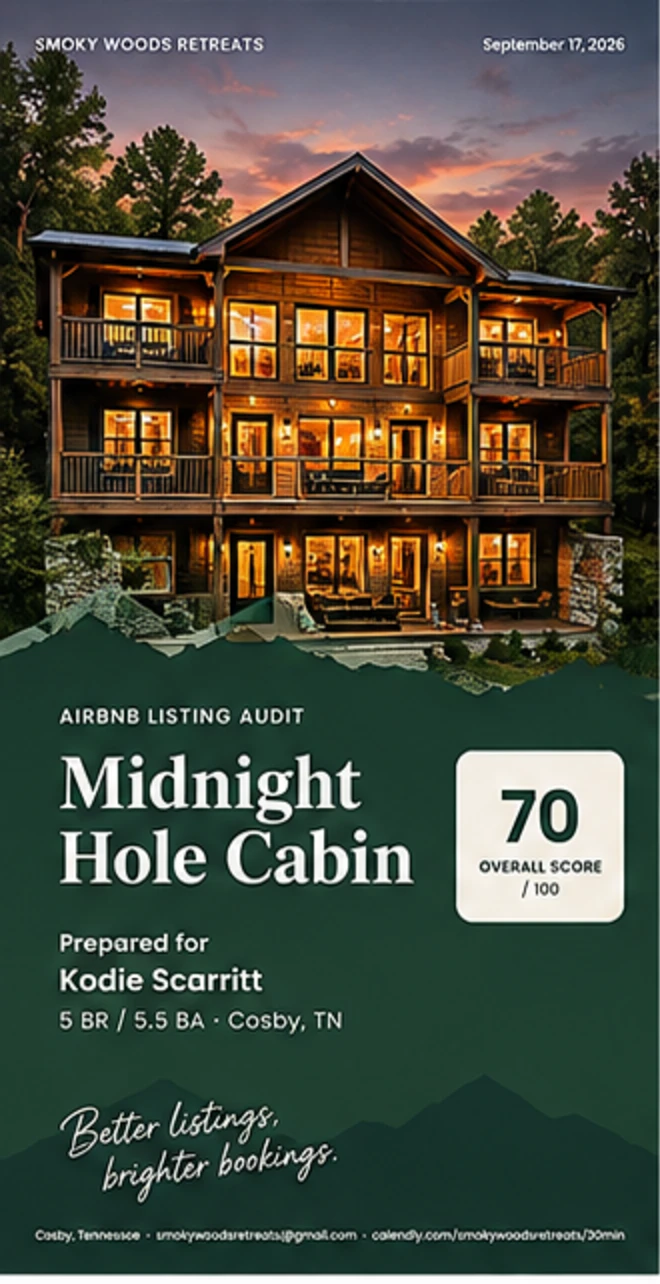 Sample audit — 8 pages, in your inbox within 24 hours