Congratulations on the cabin. Now comes the part nobody mentions at closing: there’s a real sequence to getting a Smoky Mountain short-term rental legally listed and actually booking, and doing the steps out of order is the single most common way new owners lose their first month of revenue — or worse, get flagged before they’ve hosted a single guest.
Compliance Comes Before Marketing, Not After
It’s tempting to jump straight to photos and pricing. Don’t. Depending on where your cabin sits — unincorporated Sevier County, Gatlinburg, Pigeon Forge, or Sevierville — you’re looking at a permit application, a life-safety inspection covering smoke alarms, carbon monoxide detectors, egress routes, and fire extinguishers, and in some jurisdictions a separate business license and tax registration (SkyRun). None of this is fast. Inspection scheduling alone can take months depending on the season and the fire marshal’s queue, so the permit application is the very first thing that should happen after closing — before you’ve bought a single throw pillow.
If your cabin was represented as “already an Airbnb” by the seller, don’t assume that status transfers with the deed. Verify it directly with the county or city rather than taking a listing agent’s word for it.
Property Preparation Is Bigger Than Furnishing
Furnishing and stocking the cabin is the visible part, but the categories that actually affect bookings and reviews go further: reliable high-speed WiFi, a smart lock for keyless check-in, working smoke/CO detectors tied into your inspection requirements, and a thermostat guests can actually operate without a phone call to you (Minoan). Guests judge a cabin fast, and a slow WiFi connection or a check-in process that requires a text exchange at 11pm shows up in reviews far more often than owners expect.
Taxes and Licensing Are Their Own Line Item
Beyond the STR permit itself, most jurisdictions require a separate county business license, and cities layer on their own registration and lodging tax accounts. Each of these has its own application and its own processing time, and they’re easy to miss because they don’t live in the same office or portal as the permit application. Owners who only discover a missing business license after their first booking tend to find out the hard way — through a letter, not a phone call.
Insurance Isn’t the Same as Your Old Homeowner’s Policy
A standard homeowner’s or even a standard landlord policy typically doesn’t cover short-term rental use. You need a policy written specifically for STR operation, which accounts for higher guest turnover, liability exposure from amenities like hot tubs and fire pits that are common on Smoky Mountain cabins, and business-interruption coverage if the property becomes unrentable. This is worth sorting out before your first guest checks in, not after an incident makes you find out your policy has an exclusion you didn’t know about.
Stay in It Yourself Before a Guest Does
One of the most consistently underrated steps: book yourself an overnight stay in your own cabin, as a guest would experience it, once it’s furnished and set up but before it goes live. Test the WiFi from every room, try the smart lock the way a tired guest would at midnight, run the hot tub, check water pressure and hot water recovery time with multiple people showering back to back. Problems you catch here cost you nothing. Problems a guest catches cost you a review.
The Listing Itself Isn’t One Task, It’s Several
Professional photography, a description that actually differentiates your cabin from the twenty others in the same search radius, house rules that set expectations before problems start, and a pricing strategy that accounts for Smoky Mountain seasonality — not a flat nightly rate copied from a similar-looking listing — all need to happen before you flip the listing live. Skipping any one of these doesn’t stop you from listing. It just means your first few months of bookings and reviews absorb the cost of figuring it out live.
WHERE NEW OWNERS LOSE THE MOST TIME
The number one thing we see: owners who list before their permit clears, because they didn’t realize how long inspection scheduling actually takes in this market. The second most common: owners who furnish and photograph the cabin, then realize mid-season their pricing was never adjusted for anything beyond the day they set it. Both are avoidable with the right order of operations.
Your First Ten Reviews Matter More Than Your Next Hundred
New listings get a temporary visibility boost on most platforms while the algorithm figures out where to rank you — but that window closes fast, and what fills it in is your first handful of reviews. A cabin that launches with the permitting, prep, and testing steps above handled properly tends to open strong: quick check-ins, no surprise issues, responsive host. A cabin that launches before it’s fully ready tends to collect its first few reviews during the exact window that matters most for long-term ranking, and those are hard to walk back later.
Get the Free Listing Launch Checklist
We put together the exact order-of-operations checklist we use internally when bringing a new cabin onto our own management roster — the compliance steps you need to confirm, then prep, listing, and launch, in the sequence that actually avoids the costly mistakes above. It’s free.

Or Skip the Learning Curve Entirely
If you’d rather not run point on prep, listing, pricing, and launch yourself, our 15% full-service management takes over the entire operation once your cabin is permitted and eligible to rent: listing build, photography coordination, dynamic pricing tuned to Smoky Mountain seasonality, guest messaging, cleaning and turnover, and maintenance dispatch. You get a cabin that opens strong during that first-reviews window and keeps running without you — for a flat 15% of revenue, with no setup fees.
To be clear about our role: permitting, inspections, zoning, and tax registration stay with the owner in every case, and we recommend confirming current requirements directly with Sevier County, Gatlinburg, or Pigeon Forge. Once your cabin is cleared to operate, we handle everything from there.
Book a Free Consult →
You can also see everything included in our 15% full-service management for cabins across Gatlinburg, Pigeon Forge, Sevierville, and Cosby.
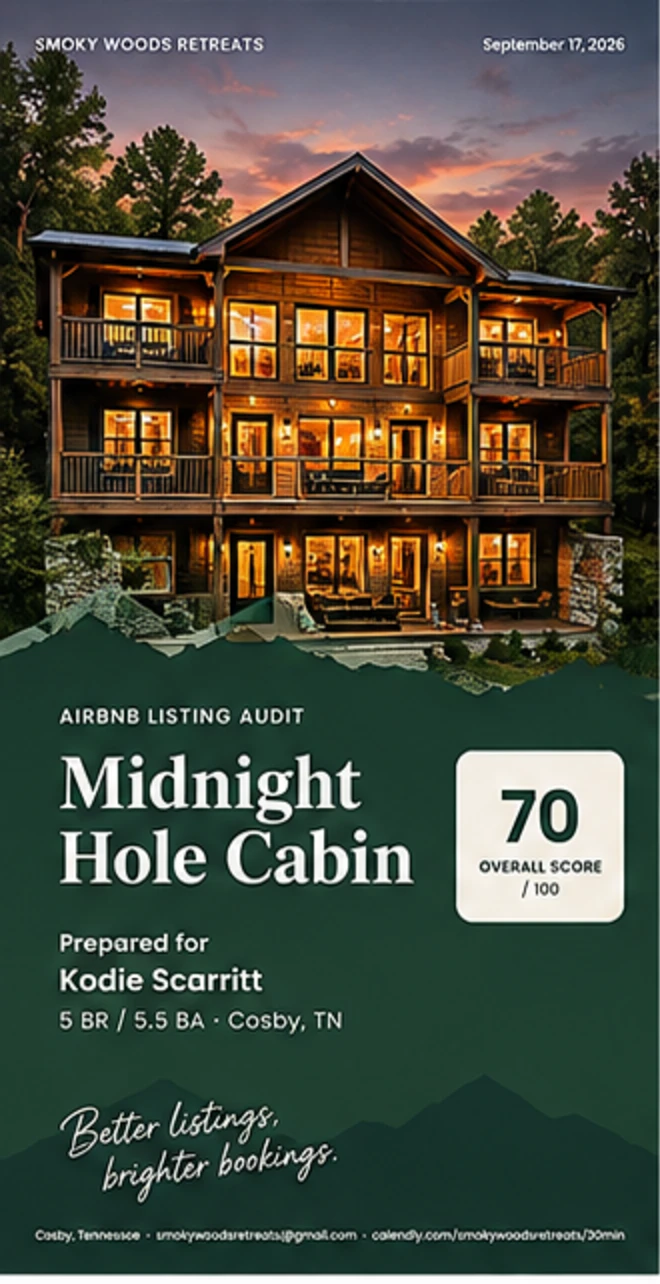 Sample audit — 8 pages, in your inbox within 24 hours