Guests decide whether to click into your listing in about 50 milliseconds, based almost entirely on your cover photo (Turno). That’s faster than they can read your title. Everything about how a photo is taken, lit, and framed happens before a guest has processed a single word of your listing — which is exactly why the gap between an amateur photo and a properly shot one is worth far more than it looks.
The “Before” Problems, Named Honestly
The most common issues aren’t about the camera. They’re about a handful of repeatable mistakes: shooting at night or without turning on every light in the room, photographing a cluttered or unstaged space, skipping angles that would actually show the layout, and picking a cover photo that doesn’t earn the click in the first half-second of a search scroll (Turno). None of these require expensive equipment to fix — they require a different process.
What “After” Actually Looks Like
A well-shot cabin photo isn’t just brighter. It’s taken with every light on plus available natural light, shot from angles that convey depth and actual room size rather than a single flat wall-on view, and staged just enough to look inviting without becoming unrealistic — because over-staging creates its own problem when guests arrive to something that doesn’t match the photos (Turno).
The Numbers Behind Why This Matters
Hosts using professional photography see roughly 40% higher earnings on average compared to similar nearby listings, and their properties get booked about 24% more often (Turno). For a Smoky Mountain cabin competing against dozens of similar listings in the same search radius, that gap is frequently the entire difference between a cabin that books consistently and one that sits open through shoulder season.
THE COVER PHOTO IS DOING MORE WORK THAN YOU THINK
Guests form their first impression from your cover image before they ever open the listing. A weak cover photo doesn’t just underperform — it filters your cabin out of consideration entirely, before the rest of your gallery, your description, or your price ever gets seen. If you improve exactly one photo, start there.
What Doesn’t Change Between Before and After
A better photo shoot doesn’t require staging your cabin as something it isn’t. The goal isn’t to trick a guest into booking something different from what they’ll get — that backfires directly in reviews. The goal is to show your actual cabin the way it looks on its best day, in its best light, from the angles that make the space read accurately. Over-staged, unrealistic photos create their own version of the same problem bad photos do: a mismatch between expectation and arrival.
Room-by-Room, Not Wall-by-Wall
One of the most common gaps in a self-shot cabin gallery is coverage: a handful of decent individual shots that never actually let a guest picture themselves in the space. A complete gallery walks a guest through the cabin the way they’d experience it in person — entry, main living space, each bedroom, the kitchen, and whatever outdoor amenity (deck, hot tub, fire pit) is part of the draw — not just whichever rooms happened to look good that day.
Seasonal Photos Matter More in This Market Than Most
A Smoky Mountain cabin photographed once, years ago, in a single season misses an opportunity most owners in flatter, less seasonal markets don’t have to think about: fall foliage, snow-dusted decks, and lush summer greenery all sell the same cabin differently depending on when a guest is searching. A gallery that only ever shows one season can feel stale to a repeat searcher, even if nothing about the cabin itself has changed.
Get the Free Airbnb Photoshoot Checklist
We put together the exact room-by-room shot list and lighting checklist we use before every cabin photoshoot — what to capture, in what order, and what to fix in the space before the camera comes out. It’s free.

If your photos are already part of a broader listing gap, our $9.99 Listing Audit will tell you plainly where photos rank against everything else that’s holding your listing back.
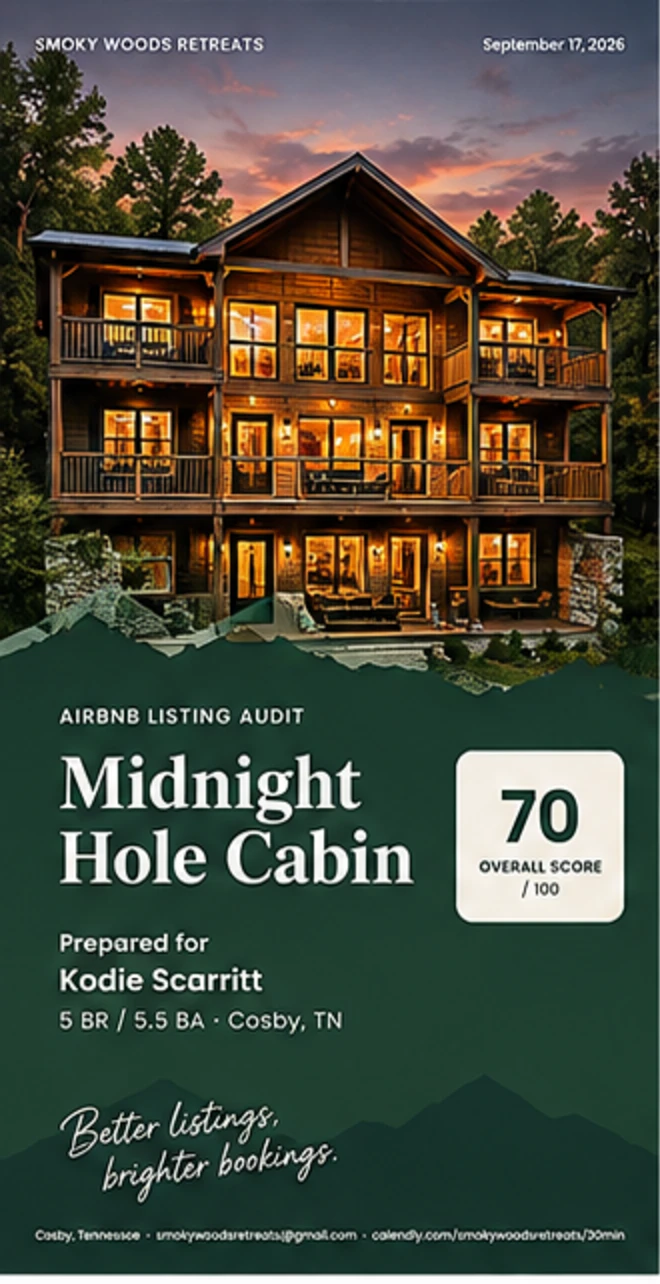 Sample audit — 8 pages, in your inbox within 24 hours